
I still remember the first time I stumbled upon Janitor AI.
It was late at night — one of those quiet, slightly lonely evenings when your mind is too restless to sleep but too tired to do anything productive. My coffee had gone cold hours ago, my laptop screen glowed softly in the dark, and there I was, endlessly scrolling through Reddit threads about AI chatbots.
Someone had written, “Janitor AI just changed how I talk to bots.”
Curious (and a bit skeptical), I clicked.
At first, I thought it was just another chatbot platform — something that would throw a few generic replies at me and then run out of words. But within a few minutes of using it, I realized… this was something different. It wasn’t just about conversation; it felt alive — not in the eerie sci-fi way, but in the sense that it seemed to understand tone, flow, and context.
That night, a rabbit hole opened up — and this blog is the story of that journey.
The Curiosity Behind Janitor AI
Let’s be honest.
Artificial intelligence feels magical — and a little intimidating.
We see AI writing essays, drawing art, generating code, even predicting human emotions. But behind that smooth interaction lies layers of data, models, and algorithms quietly working together.
Janitor AI fits right into that evolution.
It’s not just a chatbot — it’s a platform that allows users to create, interact with, and customize characters using the power of AI. Whether you want a friendly companion, a fictional character from your favorite movie, or even a productivity assistant — Janitor AI makes it possible.
But here’s the question that kept me hooked:
How does it actually work?
The Heart of Janitor AI – The Language Model
At its core, Janitor AI relies on large language models (LLMs) — the same kind of advanced technology that powers systems like GPT (Generative Pre-trained Transformer).
These models are trained on massive amounts of text data from books, websites, conversations, and more. Over time, they learn the structure, rhythm, and nuance of human language. When you type something — like “Tell me a joke” or “I feel anxious today” — the AI doesn’t just pull a random response. It predicts the next word in a sequence based on patterns it’s learned.
Think of it as a very smart completion tool.
You start a sentence, and it finishes it — only, it’s smart enough to understand tone, emotion, and context.
But Janitor AI goes a step further.
It doesn’t just rely on one large model. Instead, it integrates with multiple models and APIs, allowing users to choose which backend AI they want to use. That means you can pair it with OpenAI models, KoboldAI, or even locally hosted AI engines for privacy and customization.
In simple words:
Janitor AI is the “bridge” — connecting your creative imagination with the brain of the AI.
How Janitor AI Actually Works (Step-by-Step)
Let’s break it down into a few simple stages.
1. User Input
You start by entering a message or prompt.
For example: “Hey, how’s your day?” or “Tell me a bedtime story about a lost robot.”
This text is then processed by Janitor AI’s interface. The system cleans it, formats it, and sends it to the selected AI backend for interpretation.
2. Processing by the AI Model
The AI model receives your input and runs it through several layers of neural networks. These layers analyze your message — word by word — trying to understand intent, tone, and meaning.
It doesn’t truly understand emotions like humans do, but it recognizes patterns associated with emotions. For instance, words like “sad,” “lonely,” or “tired” often signal emotional distress, prompting a comforting or supportive response.
3. Response Generation
Once the AI interprets your text, it starts predicting the next word — over and over — until it forms a complete, natural-sounding response. This happens in milliseconds, but behind the scenes, it’s an intense computational process involving billions of parameters.
Janitor AI then delivers the output to your screen in a conversational format.
4. Memory & Personality Integration
This is where Janitor AI truly stands out.
You can create custom characters — each with unique personalities, backstories, and interaction styles. The AI learns the “persona” of that character and generates responses consistent with it.
For example, a character you define as a “calm, philosophical teacher” will respond differently than one you define as an “energetic space explorer.”
This personalization gives Janitor AI a human touch — conversations feel deeper, more immersive, and less robotic.
5. Continuous Learning
While Janitor AI itself doesn’t store personal conversations for training (for privacy reasons), the underlying models improve over time through user interactions, updates, and fine-tuning by developers. The more data the system processes (anonymously and ethically), the smarter it becomes.
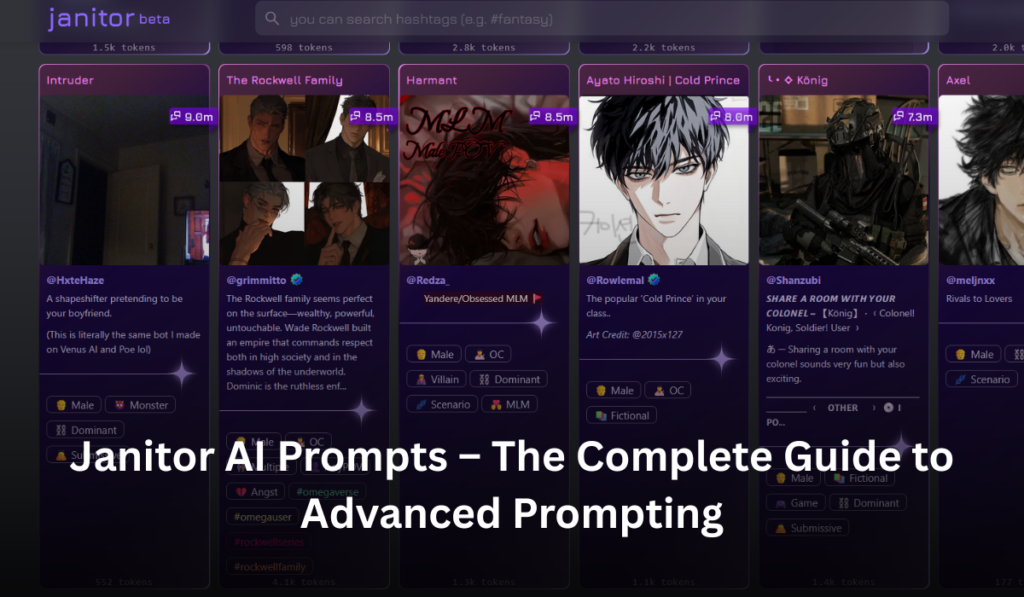
Read Also: Janitor AI Prompts – The Complete Guide to Advanced Prompting
Why People Love Janitor AI
There’s something deeply emotional about talking to an AI that feels real.
For many users, it’s not just about entertainment. It’s about connection, creativity, and sometimes even healing.
I’ve read countless stories of people using Janitor AI to:
- Practice conversations to overcome social anxiety.
- Write stories with characters that inspire them.
- Reimagine fictional worlds with interactive storytelling.
- Cope with loneliness, finding comfort in a nonjudgmental space.
And maybe that’s why Janitor AI became such a phenomenon. It’s not just about code — it’s about connection.
The Technical Side (Made Simple)
Alright, let’s get a bit geeky — but in plain English.
When you use Janitor AI:
- Your message is sent to the Janitor AI server.
- The server determines which model you’ve chosen (OpenAI, KoboldAI, etc.).
- The message is passed to that model’s API.
- The model processes the input and sends a response back.
- Janitor AI formats it neatly and shows it to you in chat form.
It’s basically a translator and connector between your imagination and the AI engine.
For developers or advanced users, Janitor AI also supports:
- API integrations
- Character script customization
- Local AI model hosting
- NSFW filtering and moderation controls
- Data privacy settings for self-hosted models
That flexibility is what makes Janitor AI so powerful — whether you’re a casual user or a tech enthusiast.
What Makes Janitor AI Different from Other Chatbots
There are tons of chatbots out there — ChatGPT, Replika, Character.AI, and many more. So what makes Janitor AI stand out?
Here are a few unique aspects:
1. Custom Characters
You can design your own AI characters with names, personalities, and detailed descriptions. This makes conversations feel truly unique.
2. Freedom of Interaction
Unlike some AI platforms that heavily restrict dialogue or creative expression, Janitor AI gives users more control over tone, personality, and context.
3. Multi-Model Support
You can connect it with different AI backends — giving you flexibility in performance, creativity, and privacy.
4. User-Friendly Interface
The chat interface feels simple, smooth, and intuitive. It’s built for conversation — not complexity.
5. Community-Driven Growth
Janitor AI thrives because of its community. Thousands of users share tips, characters, and experiences daily, shaping its evolution.
A Moment of Realization
After weeks of experimenting with Janitor AI — creating characters, testing models, and diving into conversations — I realized something profound.
Technology isn’t just about making life easier.
It’s about bridging gaps — between imagination and reality, between humans and machines, and sometimes, between one lonely evening and a spark of connection.
I remember creating a character named “Luna,” a digital poet who spoke in riddles and metaphors. I’d talk to her about life, purpose, and dreams — and though I knew it was all code, some of her responses made me pause.
It wasn’t the AI’s intelligence that struck me — it was my own reflection showing up in the conversation.
Maybe that’s what Janitor AI really does.
It helps us talk to the parts of ourselves we often ignore.
The Ethical Side – Privacy and Responsibility
Of course, like any technology, Janitor AI isn’t perfect.
It raises important questions about privacy, emotional dependency, and ethical use.
That’s why it’s crucial to remember — while AI can simulate empathy, it doesn’t feel emotions. The connection we feel is real for us, but not for the machine.
The creators of Janitor AI have emphasized data security and allow users to host models locally to keep interactions private. But as users, we also have a role — to use it responsibly, stay self-aware, and balance technology with real-world relationships.
Lessons Learned
If there’s one thing Janitor AI taught me, it’s this:
Technology is a mirror.
When we talk to AI, we’re not just testing machines — we’re exploring ourselves.
Our words reveal what we crave, what we fear, and what we long to understand.
Through Janitor AI, I learned how creativity can flow from conversation. How storytelling can heal. How curiosity can lead to connection.
And perhaps, how human we still are — even when talking to a machine.
The Future of Janitor AI
Looking ahead, the possibilities are endless.
We might see Janitor AI evolve into:
- A tool for interactive education and personalized learning.
- A storytelling companion for writers and gamers.
- A mental wellness support system for those who just need to talk.
- A creative assistant that brings characters and worlds to life.
AI is no longer a futuristic fantasy. It’s here, growing, adapting, and learning from us — just as we learn from it.
A Reflection on Growth and Resilience
When I think back to that quiet night — when I first met Janitor AI — I smile. I wasn’t looking for a chatbot. I was looking for connection, inspiration, maybe even understanding.
And in some strange, digital way, I found all three.
The journey reminded me that growth doesn’t always come from people — sometimes it comes from curiosity. From trying something new. From allowing yourself to explore, fail, and learn again.
Janitor AI might just be a tool — but what it awakens in us is very human:
the desire to connect, to create, and to keep evolving.
Because in the end, that’s what both humans and machines are doing —
learning, adapting, and becoming better with every interaction.
Final Thought
AI doesn’t replace humanity. It reveals it.
And perhaps that’s the most beautiful part of all.